Redesign Your Dining Room in Transitional Style with AI
Discover the perfect equilibrium between the warmth of traditional design and the clean, uncluttered lines of contemporary aesthetics. At AI-Architectures.com, we empower homeowners, interior designers, and architects to instantly visualize breathtaking transitional dining spaces using state-of-the-art artificial intelligence.
The Essence of Transitional Architecture & Interior Design
Transitional style is the masterful art of balance. It bridges the gap between the ornate, classical elements of traditional architecture and the minimalist, functional ethos of modern design. When applied to a dining room—a space inherently designed for gathering, connection, and celebration—the transitional aesthetic creates an environment that is both deeply inviting and refreshingly sophisticated.
Unlike strictly traditional spaces that can feel heavy or dated, or ultra-modern rooms that risk feeling cold and clinical, transitional design embraces a cohesive narrative. It relies on a neutral color palette, tactile fabrics, and streamlined furniture silhouettes set against classic architectural backdrops like crown molding, coffered ceilings, or detailed millwork.
With the proprietary rendering engine at AI-Architectures.com, designing within this nuanced style is no longer a painstaking process of trial and error. Our AI understands the delicate ratios of classic to contemporary, allowing you to generate photorealistic dining room redesigns that honor the transitional philosophy flawlessly.
Core Elements of Transitional Dining Rooms
- ✦Architectural Foundations: Classic moldings, wainscoting, and arched doorways retained or added for historical depth.
- ✦Furniture Silhouettes: Clean lines with gentle curves. Avoiding excessive ornamentation or rigid geometric harshness.
- ✦Textural Layering: Combining wood, glass, metallic accents, and rich fabrics like velvet, linen, and chenille.
- ✦Color Palette: Tone-on-tone neutrals, warm greys, taupes, vanilla, and soft charcoals.
- ✦Statement Lighting: Contemporary fixtures—such as linear suspensions or abstract chandeliers—acting as the modern anchor in the room.
Transforming Spaces: A Visual Case Study
Witness the power of AI-Architectures.com. By analyzing an existing, uninspired space, our artificial intelligence reimagines the volume, lighting, and materiality to establish a breathtaking transitional dining room.
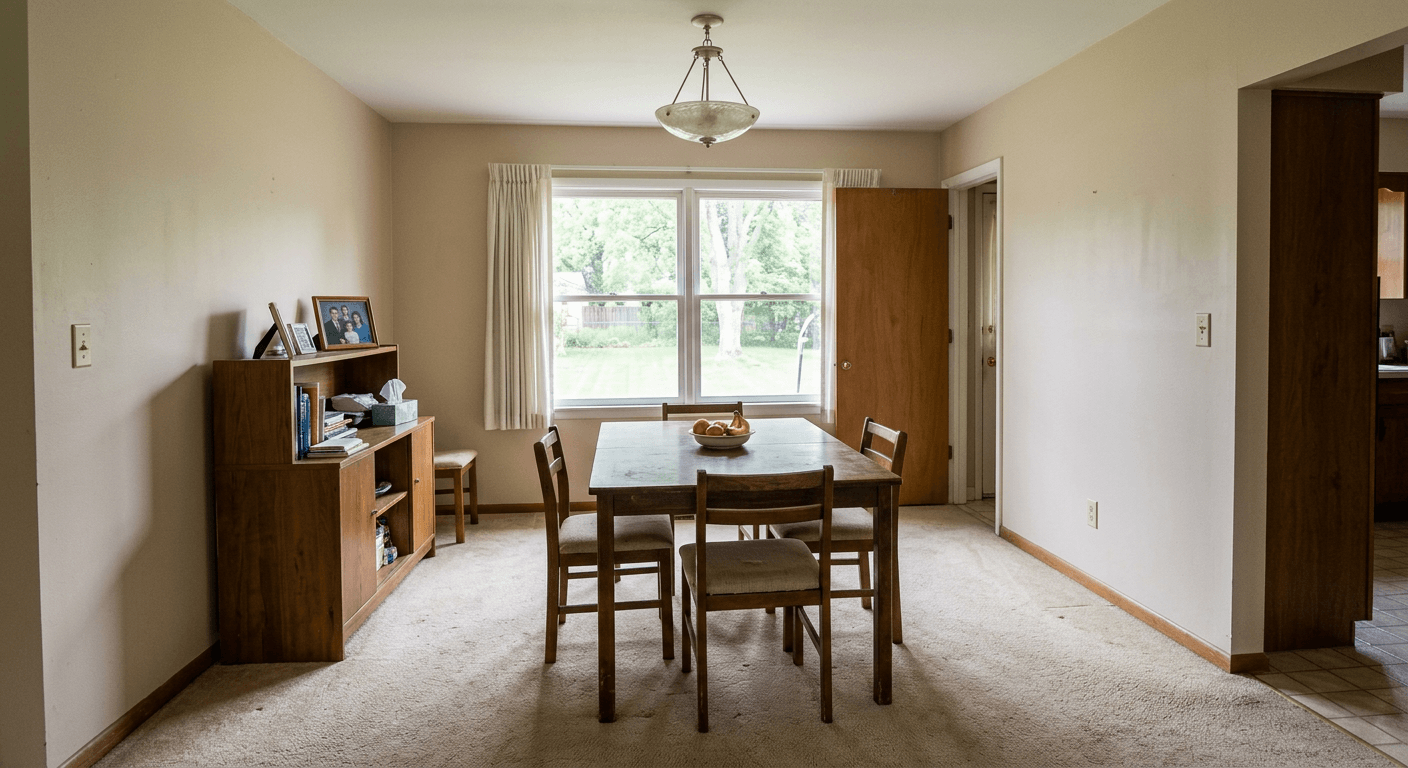
The Original Canvas
The original space lacks cohesive direction. While it features decent structural volume and natural light, the layout is uninspired, the color palette is disjointed, and the architectural details are either hidden or nonexistent. The room feels empty, lacking the warmth and functional elegance required for a proper dining experience.
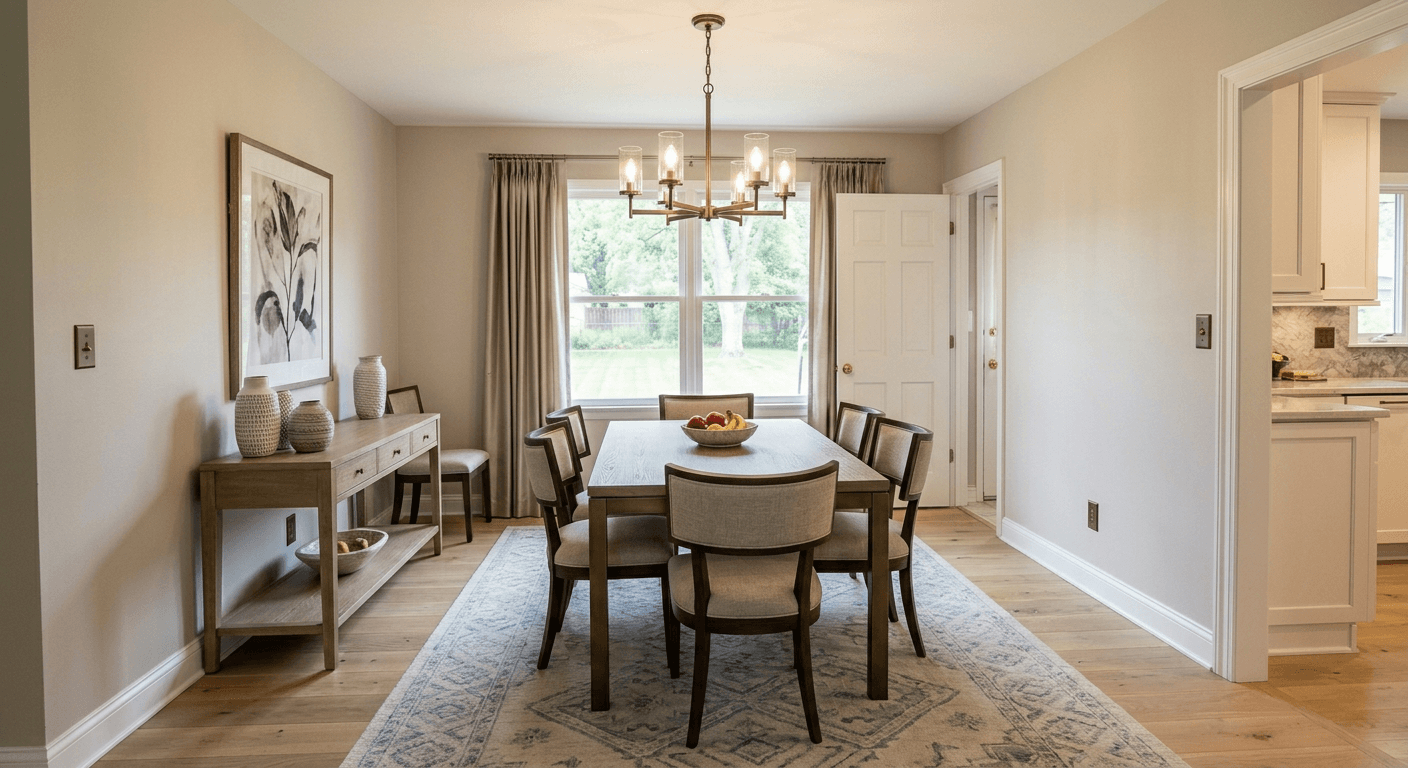
The Transitional Masterpiece
Our AI engine has entirely revitalized the room. Notice the introduction of subtle wall paneling (a nod to traditionalism) paired with a bold, contemporary linear lighting fixture. The warm, neutral tones are elevated by contrasting dark wood accents and plush, modern upholstered seating. The result is a space that is sophisticated, timeless, and perfectly balanced.
How AI-Architectures.com Revolutionizes the Redesign Process
1. Instant Conceptualization and Iteration
Historically, visualizing a transitional redesign required weeks of drafting, mood board creation, and costly 3D rendering. With the advanced neural networks powering AI-Architectures.com, users can generate high-fidelity concepts in seconds. Whether you want to test how a classical Persian rug pairs with a mid-century modern credenza, or how matte black wainscoting affects the spatial perception of your dining room, the AI delivers instant visual feedback.
2. Perfecting the Lighting Strategy
Lighting is arguably the most critical component of transitional design. It bridges eras. Our AI understands photometric lighting principles. When you prompt it for a "transitional dining room," it intrinsically knows how to balance ambient natural daylight with the dramatic focal point of an oversized contemporary chandelier, whilst layering in soft traditional wall sconces. The AI algorithms calculate realistic shadows, reflections on glass tables, and the diffusion of light through sheer window treatments, providing a true-to-life architectural rendering.
3. Intelligent Material and Texture Matching
A successful transitional space avoids the starkness of pure modernism by layering rich textures. Our AI engine is trained on thousands of high-end architectural materials. It seamlessly blends distressed hardwoods, polished brass, heavily textured bouclé, and smooth marble. By using our platform, designers can prompt specific material palettes, allowing the AI to organically map these textures onto furniture and architectural forms, ensuring the digital representation is as tactile and inviting as the real-world execution.
4. Spatial Optimization and Furniture Layout
Dining rooms require precise spatial planning. The distance from the table to the wall, the scale of the credenza, and the height of the lighting fixture all matter. AI-Architectures.com evaluates the spatial volume of your uploaded "Before" image and intelligently scales the "After" furnishings. The AI respects architectural boundaries, ensuring that the generated transitional dining room isn't just a beautiful concept, but a viable, ergonomically sound design ready for real-world implementation.
Pro Tip for AI Prompts:
When using our Interactive Design Widget, be specific about the architectural eras you want to bridge. For example, specify "Victorian crown molding" combined with "Bauhaus-inspired dining chairs." The more precise you are with your material and stylistic inputs, the more breathtaking and customized your transitional AI output will be.
Ready to Define Your Dining Space?
Stop relying on imagination alone. Utilize the premier architectural AI at AI-Architectures.com to visualize, iterate, and perfect your transitional dining room redesign today. The future of interior design is here, and it is beautifully rendered.